
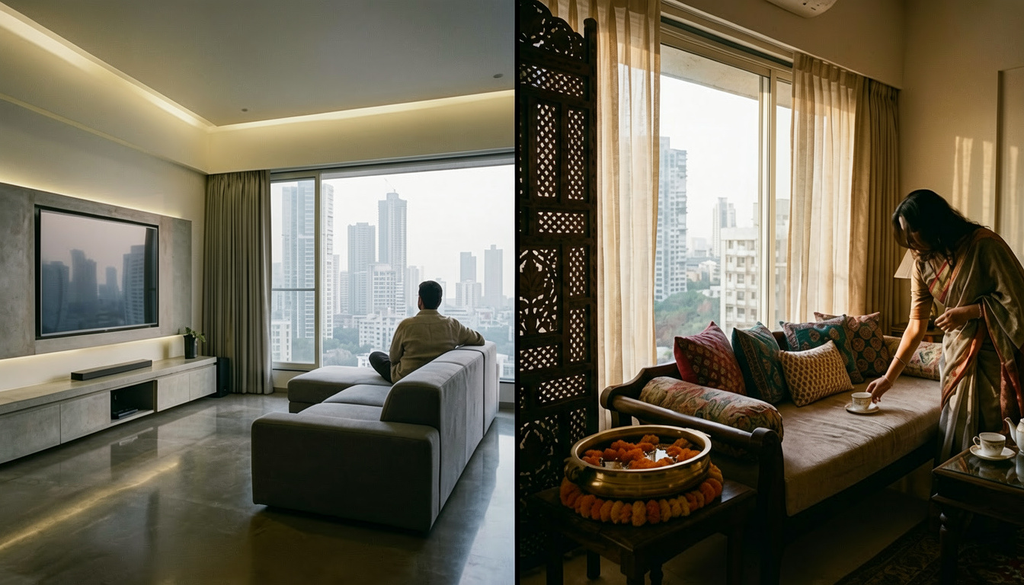
Of all the style debates homeowners work through during planning, modern vs traditional interior design is probably the most common — and the least likely to have a single right answer. Both approaches can produce genuinely beautiful, functional homes; the right choice depends on maintenance tolerance, budget structure, and how you want your home to feel day to day, not on which style is objectively “better” in some universal sense. This comparison walks through the honest trade-offs between the two, across cost, upkeep and long-term appeal.
What Modern vs Traditional Interior Design Actually Means
Modern interior design favours clean lines, restrained ornamentation, and a neutral palette with occasional bold accents, prioritising function and simplicity in both form and material choice. Traditional interior design draws on richer colour palettes, ornate detailing, carved wood furniture, and often specific cultural or family elements — a mandir unit, heirloom furniture pieces, brass and metal accents — that carry personal significance beyond pure aesthetics. Neither is inherently more “correct”; they simply represent different underlying philosophies about what a home should feel like and how it should function day to day.
Modern Interior Design: Core Characteristics
Modern spaces typically use built-in storage to keep surfaces clear, favour geometric furniture forms over decorative ones, and rely on a neutral base palette punctuated by carefully chosen accents rather than layered pattern and colour throughout. This approach suits households that value a calm, uncluttered visual environment and are comfortable with some ongoing discipline about keeping surfaces clear, since modern spaces show clutter more visibly than busier, more layered traditional interiors do, where additional objects blend into an already-rich visual environment.
Traditional Interior Design: Core Characteristics
Traditional spaces embrace visual richness — detailed woodwork, warmer and more saturated colour palettes, decorative textiles, and often a greater density of furniture and decorative objects throughout a room. This style tends to suit households that value warmth, cultural continuity, and a sense of established permanence over the more restrained, ever-changing aesthetic that modern design often pursues, offering a sense of rootedness that some households find genuinely more satisfying to live with daily.
Lighting Approaches in Each Style
Modern interiors typically favour recessed, track or minimal pendant lighting that stays visually unobtrusive, letting the room’s architecture and furniture carry the visual interest rather than the fixtures themselves. Traditional interiors often incorporate lighting as a deliberate decorative statement — chandeliers, ornate wall sconces, brass fittings — treating fixtures as jewellery for the room rather than purely functional elements meant to disappear into the background. Neither approach is more functionally effective than the other; the difference is almost entirely about whether lighting is meant to be noticed or meant to recede.
Spatial Planning Differences
Modern design tends to favour open, flowing layouts with minimal visual separation between zones, relying on furniture arrangement rather than physical division to define different areas of a room. Traditional design more often embraces distinct, separately defined rooms and zones, sometimes with visual thresholds — a change in flooring material, a decorative arch, a step — marking the transition between spaces. This spatial philosophy difference matters particularly in how a home feels to move through daily, beyond just how individual rooms look in isolation.
Cost Comparison
Traditional design’s custom carpentry, detailed woodwork and often larger furniture pieces generally cost more than modern design’s simpler, cleaner-lined furniture and finishes. This isn’t a universal rule — a modern space with premium materials can easily cost more than a modestly furnished traditional one — but as a general pattern, the level of customisation and ornamentation traditional design typically involves does correlate with higher costs across carpentry and furnishing budgets specifically.
Maintenance and Upkeep Comparison
Modern design’s simpler surfaces and reduced ornamentation are generally easier to clean and maintain day to day, with fewer decorative crevices and less visible dust-collecting detail. Traditional design’s carved woodwork, textiles and denser furnishing require more regular upkeep to stay looking their best, though this maintenance difference is often smaller in practice than the aesthetic difference might suggest, particularly with modern durable finishes now available for traditional-style furniture pieces that reduce the maintenance burden without sacrificing the overall visual character.
Resale and Long-Term Appeal Comparison
Modern design’s broader current popularity generally means it appeals to a wider range of potential buyers if resale is a consideration, since its neutral base is easier for a new owner to adapt to their own taste. Traditional design, particularly when it incorporates highly personal or culturally specific elements, may appeal more narrowly, though a well-executed traditional home with quality materials retains genuine long-term value regardless of shifting broader style trends, especially in markets where traditional aesthetics remain consistently valued by a meaningful segment of buyers.
Which Style Suits Different Household Types
Modern design tends to suit smaller households, younger homeowners furnishing a first home, or anyone prioritising low-maintenance daily living. Traditional design tends to suit multi-generational households, homeowners with strong cultural or family design preferences, or those who simply find warmth and visual richness more personally satisfying than restrained minimalism, regardless of broader trend considerations that might otherwise push them toward a more currently fashionable direction.
Can You Genuinely Blend Both?
Most successful homes, in practice, don’t commit purely to one style — they blend modern layouts and storage-focused planning with specific traditional elements retained deliberately, like a mandir unit designed thoughtfully or heirloom furniture incorporated into an otherwise contemporary room. This hybrid approach often serves multi-generational households particularly well, letting different family members’ preferences show up somewhere in the finished home without either style dominating entirely or requiring one generation’s taste to be sacrificed for another’s.
Furniture Scale and Proportion in Each Style
Modern furniture tends toward slimmer profiles and lighter visual weight, designed to let empty space read as intentional rather than unfinished. Traditional furniture more often embraces substantial, solid proportions — a heavier dining table, a fuller sofa silhouette — that read as grounded and permanent rather than sparse. Neither approach is inherently more comfortable or functional; the difference is primarily about how much visual and physical presence furniture is meant to have within a room, and this distinction is often what homeowners respond to most strongly when first forming a preference between the two styles.
Materials Across Both Styles
Whichever style direction you choose, material quality fundamentals stay consistent. For carpentry, confirming BIS certification under IS 303 gives you a verifiable quality standard regardless of aesthetic direction, since style and material durability are genuinely separate considerations that shouldn’t be conflated when comparing quotes from different providers.
A Practical Decision Framework
Ask yourself honestly: how much daily maintenance discipline do you actually want to commit to, how much do specific cultural or family elements matter to you regardless of overall aesthetic, and is resale value a near-term consideration or a distant one? Your honest answers to these questions point more reliably toward the right choice than any general assumption that one style is simply “better” than the other in the abstract.
Common Misconceptions
- “Modern always costs less”: A modern space with premium materials can easily exceed the cost of a modestly furnished traditional one.
- “Traditional means outdated”: Well-executed traditional design, refreshed with current materials and finishes, feels considered rather than dated.
- “You have to choose one or the other”: Most successful homes blend elements from both rather than committing purely to a single style.
- “Modern is objectively easier to live with”: This depends entirely on the household — some find modern restraint genuinely stressful to maintain, not simpler.
Working With an Interior Design Company in Pune
Ekratna Interiors & Constructions helps homeowners navigate this exact decision, translating personal preferences into a coherent style direction rather than defaulting to whichever aesthetic happens to be trending at the moment of the first consultation. You can explore our full range of interior design services, learn more on our about us page, see completed projects on our projects page, or browse more ideas on our blog. Follow current work on Instagram and Facebook, or reach out through our contact page to discuss your style direction.
Conclusion
Neither modern nor traditional interior design is universally better — the right choice depends on your household’s actual daily habits, maintenance tolerance, and how much personal or cultural significance specific design elements carry for you. Being honest about these factors, rather than choosing based purely on which style is currently trending, consistently produces a home that feels genuinely right years after the initial decision rather than one that starts to feel wrong within a season or two, once the novelty of a trend-driven choice has worn off.
Still deciding between modern and traditional?
Ekratna Interiors & Constructions can help you find the right balance for your home, budget and lifestyle.
Request a ConsultationFrequently Asked Questions
Is modern interior design always cheaper than traditional?
Not necessarily — a modern space with premium materials and finishes can cost more than a modestly furnished traditional home, despite traditional design’s generally higher customisation costs on average.
Which style is easier to maintain?
Modern design generally requires less day-to-day upkeep due to simpler surfaces and fewer decorative details, though this gap is often smaller in practice than expected.
Can I combine modern and traditional elements in one home?
Yes — most successful homes blend both, retaining specific traditional elements deliberately within an otherwise contemporary layout rather than committing purely to one style.
Which style has better resale value?
Modern design’s broader current appeal generally suits a wider range of potential buyers, though well-executed traditional design with quality materials retains genuine long-term value too.
How do I decide which style is right for my home?
Honestly assess your maintenance tolerance, how much cultural or family elements matter to you, and whether resale is a near-term consideration — these factors matter more than trend popularity.